
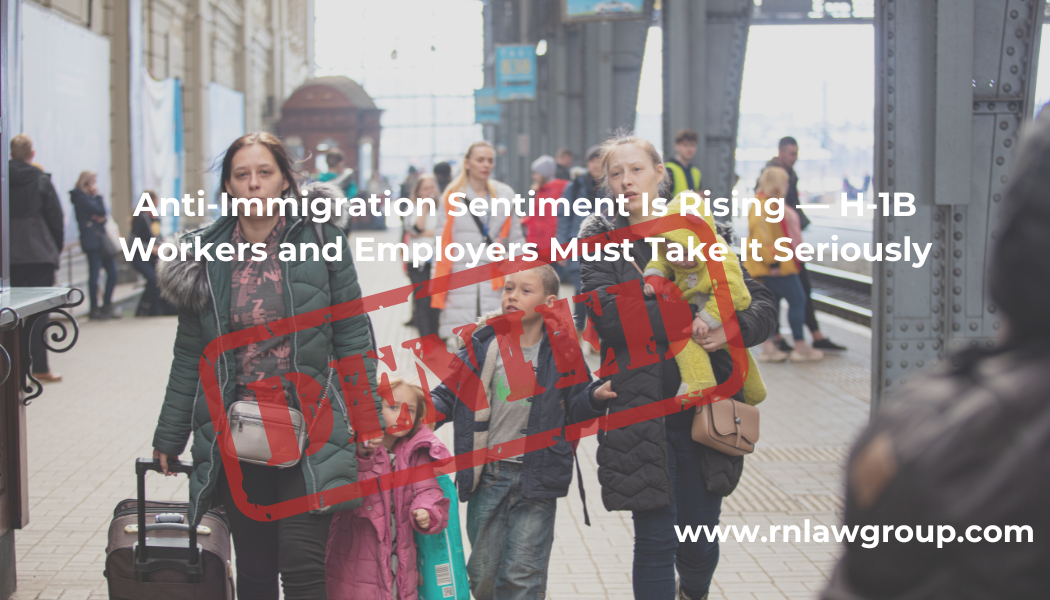
Anti-Immigration Sentiment Is Rising — H-1B Workers and Employers Must Take It Seriously
Anti-immigration sentiment is no longer background noise. It is driving political debate, influencing policy, and shaping the environment in which legal immigrants live and work. For H-1B workers and the companies that sponsor them, this is not theoretical—this is real.
Across social media and YouTube, immigration commentators are sounding the alarm. Some paint a stark picture of risk; others call for reform. Many are voice pieces advocating for fairness, clarity, and lawfulness. What unites them is a shared reality: the environment around immigration—especially employment-based immigration—is changing.
“Not all H-1B workers are the same—and not all employers are bad actors.”
This is a critical point too often lost in the noise. Yes, there have been cases of fraud, abuse, bad lawyers, and irresponsible employers. But those outliers do not define the millions of high-skilled workers who follow the rules, file transparently, and contribute meaningfully to the U.S. economy. The narrative must reflect nuance, not stereotypes.
Yet the political climate increasingly lumps legal immigrants into broad categories: job takers, circuitous exploiters of loopholes, or convenient scapegoats in elections. This oversimplification has consequences. It feeds fear, justifies aggressive enforcement, and emboldens policies that treat lawful immigrants with suspicion rather than welcome or fairness.
“Being lawful doesn’t always protect you from uncertainty.”
That’s a reality many H-1B professionals are discovering. We see it in extended processing times, heightened Requests for Evidence, inconsistent adjudications, and tougher scrutiny of extensions and transfers. Travel risks have increased, and sudden layoffs can quickly trigger immigration status complications that can upend a person’s life, family, and career.
Make no mistake: bad actors deserve enforcement. Bad lawyers and irresponsible employers should face consequences. But policy and enforcement that penalize everyone based on the actions of a few are not just unfair—they are harmful to U.S. competitiveness.
This is why it’s time to pay attention and take this seriously.
Immigration planning can no longer be reactive. H-1B holders need strategies that consider contingencies: green card backlogs, job mobility, alternative status options, compliance readiness, and travel plans. Employers must invest in compliance, anticipate policy shifts, and protect their foreign-national workforce.
Public debate will continue. YouTubers, advocates, lawyers, and commentators will offer perspectives. Some will be alarmist. Some will be inaccurate. Others will be rooted in law and experience.
But the lived reality for H-1B professionals and sponsoring employers is clear: the environment is more complex, more scrutinized, and more volatile than in past years. It’s time to treat immigration strategy with the same seriousness as any corporate or personal financial plan.
The rules may not have all changed overnight—but the attitude toward immigration has. And that changes everything.
By: Rahul Reddy

Rahul Reddy is the founding partner of Reddy Neumann Brown PC. He founded our firm in 1997 and has over 28 years of experience practicing employment-based immigration. Rahul‘s vast knowledge of the complex immigration system makes him an invaluable resource and an expert in the field. His personal experience with the immigration system has made him empathetic to each of his clients’ cases and empowered him to help others achieve the American Dream.
Rahul‘s dedication to serving the immigrant community is evident, from his daily free conference calls to his weekly immigration Q&As on Facebook and YouTube Live. He is an active member of the immigrant community and one of the founders of ITServe Alliance. He has been a member of American Immigration Lawyers Association since 1995.